Shame
I am grateful to Donald Nathanson, M.D. for teaching me about the complex range of human responses to feelings of shame, and describing the universal triggers to shame. Shame is a very painful and powerful emotion. According to Dr. Nathanson, it typically follows a moment of exposure, and this uncovering reveals aspects of ourselves of a peculiarly sensitive, intimate, vulnerable nature. Shame may also occur when interest and enjoyment are diminished but not completely terminated.
What one is ashamed about clusters around several issues:
The trigger of shame between two people is the breaking of a “bond” or “bridge” during which we feel cut off from our fellow human beings.
The three ways in which humans trigger shame in each other are through:
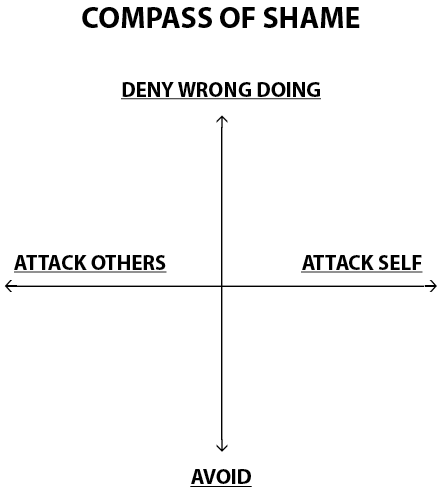
Unhealthy Response Styles To Feelings Of Shame
Displayed is a graphic depiction of the “Compass of Shame”, designed by Donald Nathanson, M.D., to help us understand how we may unhealthy respond, when we experience a moment of shame.
Envy and Jealousy
Feelings of envy and jealousy are often rooted in feelings of shame. Both involve feelings of shame, and loss of self-esteem. Envy may be triggered when you encounter someone who has something, either within yourself or a possession, that you lack. Envy is connected with feelings of inferiority, negative feelings towards a person who has what you want, and a nagging feeling of longing for those missing qualities within yourself, or possessions, that you feel are lacking or missing.
Those who feel envy often know that it is not socially acceptable. Likewise, it is not unusual for the envious person to feel happy or relieved when the envied person looses what was prized. Jealousy, on the other hand, is concerned with the potential loss of a valued relationship that you already have, or loss of an opportunity to gain a relationship that you want to have. In contrast to envy, certain expressions of jealousy are socially acceptable. Often there are painful feelings of anger, fear of loss, hurt , and a wish to get even with someone.
Often times envy, and jealousy can be experienced at the same time.. For example, the circumstances that trigger jealousy of one’s partner may then lead to comparing oneself with one’s rival, then leading to envy of the rival. Likewise, feeling envious of someone may lead to judging someone as a rival for one’s partner, and lead to feeling of jealousy towards your partner.
Shame and Lying
Many, but not all forms of lying have their roots in shame. One classification scheme for lying, detailed in the book, “Lies, Lies, Lies, The Psychology of Deceit”, by Charles V. Ford, M.D.) is as follows:
The Type of Lie……….The Reason Behind the Lie
The Content Of An Apology
Historically, people have avoided apologizing for misbehavior because of issues of pride and the wish to avoid feelings of shame. We have now come to learn that apologizing provides emotional benefits to those who give and receive them. A sincere apology consists of five core components: